

Is Highway Driving Better for Your Car Than City Driving?

Yes. Highway driving is usually easier on a car than stop-and-go city driving because steady speed cuts brake use, lowers tire scrubbing, reduces transmission shifting, and keeps engine load steadier; the main exception is very short city trips that never let the engine reach full temperature. Skip the difference and you can spend more on fuel, oil contamination, carbon buildup, and early brake or battery wear. This guide explains what highway miles help, what they still stress, and how gasoline cars, hybrids, and higher-mileage vehicles differ.
Fuel economy and wear don’t always match
For most gasoline cars, yes. A long, steady drive usually lowers fuel use and trims stop-start wear, but it does not remove all stress. High speed increases wind drag, long runs build heat, and road debris still hits tires, paint, and glass. So the answer is better for some systems, worse for a few others.
Fuel economy and wear are not the same thing
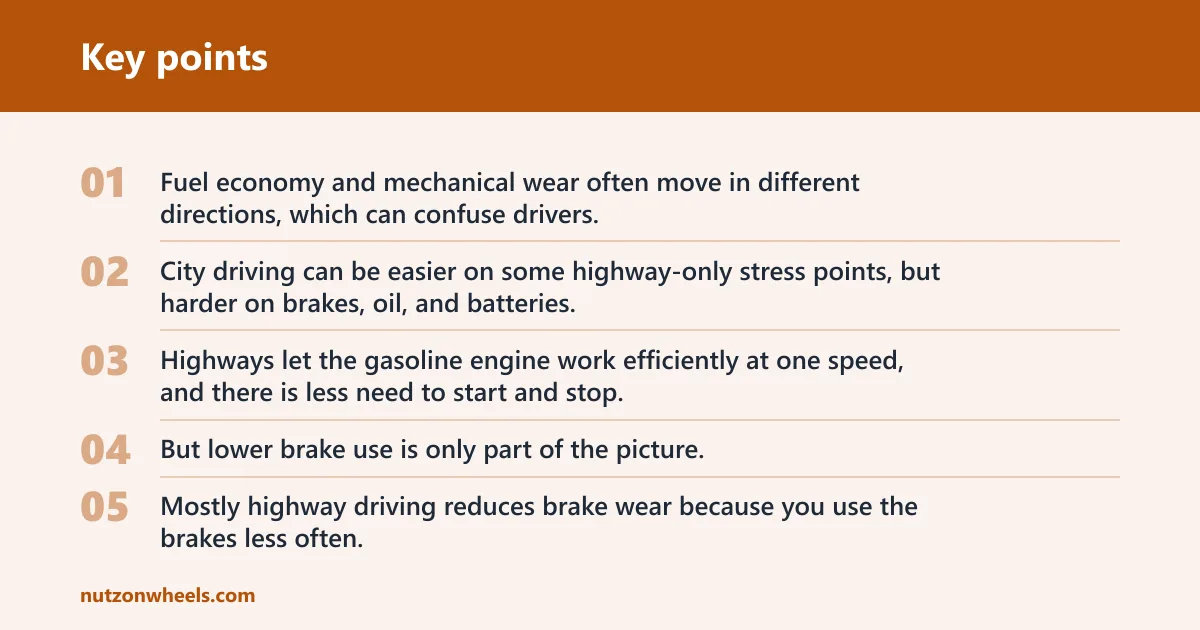
Fuel economy and mechanical wear often move in different directions, which can confuse drivers. Highway driving usually improves fuel economy because the engine can run at a steadier load and speed, yet the same trip can still add heat load and tire wear. City driving can be easier on some highway-only stress points, but harder on brakes, oil, and batteries.
That split matters. A car can use less fuel on the highway and still need brakes, tires, or cooling parts sooner if it spends a lot of time at speed, carries a roof box, or runs with low tire pressure.
Where highway driving helps most
Internal combustion engines are generally more efficient at a steady cruising speed than during repeated acceleration, braking, and idling. Highways let the gasoline engine work efficiently at one speed, and there is less need to start and stop. That steadiness usually helps the transmission too, because it avoids constant ratio changes and shift hunting.
Brakes also thank you. Less stopping means less pad and rotor wear, and regenerative systems on hybrids can recover energy that would otherwise become heat. But lower brake use is only part of the picture.
Brakes, tires, and heat exposure
Mostly highway driving reduces brake wear because you use the brakes less often. The tradeoff is sustained load. Long, fast runs raise component temperatures and can increase tire heat over time, especially on hot pavement or when the vehicle is heavily loaded. That is why a car can be easy on pads but still show tire aging and more frequent alignment checks.
Highway driving also increases exposure to stone chips, wind blast, and debris. Those are not fuel issues, but they do affect maintenance. A windshield chip or a cracked grille is still wear.
Battery charging and accessory load
City driving can be harder on battery charging because short trips may not give the alternator enough time to restore the battery fully. Air conditioning can add load, especially during slow city driving, where the engine spends more time idling and the cooling system works harder for less forward motion. Longer highway trips usually give the charging system more time to recover.
That said, a weak battery can still struggle on long highway stretches if the vehicle has heavy electrical loads or poor charging system health. Highway driving does not fix a failing battery; it only removes some of the strain patterns that drain it faster in town.
Highway driving comparison table
| Driving condition | Engine | Brakes | Transmission | Tires | Battery | Fuel use | Likely maintenance impact | Highway helps | City helps | Watch-outs | Decision rule |
|---|---|---|---|---|---|---|---|---|---|---|---|
| Steady highway cruise | Steadier load, less idling | Less frequent use | Fewer shifts | Constant rolling wear | Usually more charging time | Usually lower than city | Lower brake wear; watch heat and tire pressure | Yes | No | High speed raises aerodynamic drag quickly | Gasoline car: usually better than city; hybrid: depends on speed; high-mileage car: good if cooling and tires are sound |
| Stop-and-go city route | More acceleration and idling | More pad and rotor wear | More shifting activity | Short, repeated loads | Can recover energy in hybrids | Usually higher than highway | More brake and oil stress; more battery cycling | No | Yes for hybrids | Repeated braking wastes fuel in gasoline cars | Gasoline car: usually worse than highway; hybrid: can be better than highway; high-mileage car: short trips can be hardest on oil and charging |
| Fast highway travel | Higher sustained load | Still low use | Still steady, but hotter | Heat and wear rise | Little change | Can rise sharply | More tire heat, more wind and debris exposure | Only partly | No | Drag rises rapidly as speed increases | Gasoline car: efficient only at moderate speed; hybrid: advantage shrinks at speed; high-mileage car: watch cooling, tires, and alignment |
| Short-trip city use | May not warm fully | Frequent braking | Frequent changes | Lower average speed, but more stop-start load | More drain, less recovery | Often worst for fuel use | Oil contamination, condensation, and battery strain | No | Sometimes for hybrids | Cold starts and short run times are hard on fluids | Gasoline car: hardest on wear if trips stay short; hybrid: city can still be efficient; high-mileage car: short trips are often the least friendly |
Can highway speeds hurt fuel economy?
Yes. Highway driving often gives better fuel economy because the vehicle can keep momentum, but very high speed can erase that gain quickly. Aerodynamic drag rises fast as speed increases, and once drag becomes the main load, MPG can drop even if traffic is light and the road is flat.
Speed, wind, and vehicle shape
There is no single speed that works best for every vehicle. Cruising speed depends on gearing, road conditions, load, and the body shape of the car. A boxy SUV usually pays a bigger drag penalty than a low sedan, and a roof box can make the loss worse. Headwinds act like added speed, so they create the same drag problem.
A common mistake is assuming every long freeway trip is gentler on a car than short neighborhood drives. A 75 mph trip with a roof box and a headwind can use noticeably more fuel than a calmer 60 mph run in the same vehicle.
Why tire pressure still matters on the highway
Underinflated tires increase rolling resistance. That adds fuel demand on every road type, including the highway, because the engine has to push against more resistance all the time. Since highway driving depends so much on steady motion, even a small pressure loss can cut into the fuel savings you expected.
-
Check tire pressure cold.
Use the pressure listed on the driver-door placard, not the sidewall maximum. Check before driving or after the car has sat for several hours, because warm tires read higher. -
Remove extra drag.
Take off roof boxes, empty racks, and cargo you do not need. Anything that catches air raises the fuel penalty at speed. -
Hold a moderate cruising speed.
Pick the lowest steady speed that keeps you with traffic and within the limit. Fast highway driving can sharply reduce MPG even though the route feels easy.
Short trips can be hard on fluids
Short-trip city driving can be harder on oil, condensation control, and battery charging than longer highway trips. The engine may never fully warm up, moisture can stay in the oil and exhaust system, and the battery has less time to recover. A car used mostly for quick errands can sometimes show more wear than the odometer suggests.
Suppose a sedan makes two-mile errands all week and one 40-mile highway run on Saturday. The highway trip helps burn off moisture and recharge the battery, but it does not erase the short-trip wear that built up during the week.
What maintenance matters most for mostly highway driving?
Tire pressure, alignment, filters, spark plugs, and oil condition matter most. Highway miles may reduce brake wear, but they do not remove the need to keep the engine breathing clean air, the oil in good condition, and the tires properly inflated. High speed also makes small issues show up faster.
Tire pressure and alignment
Start with tire pressure. It affects rolling resistance, fuel use, heat, and tread wear. If the car drifts, pulls, or wears tires unevenly, an alignment check matters because highway miles can magnify those symptoms over long distances. A misaligned car can waste fuel and chew through tires faster than city use would suggest.
Oil, filters, and spark plugs
Oil condition matters because long, hot runs can thin old oil faster, while short trips can contaminate it with moisture and fuel dilution. Filters and spark plugs matter because an engine that breathes and ignites properly works less hard for the same output. Maintenance cuts extra engine work, which helps both city and highway use.
-
Follow the service schedule.
Follow the mileage and time interval in the owner’s manual for oil, air filter, cabin filter, and spark plugs. Do not stretch intervals just because most miles are highway; time still ages fluids and filters. -
Inspect tires regularly.
Look for uneven wear, bubbles, punctures, and embedded debris. Highway tires take more heat and more stone impact, so visual checks matter even when tread looks fine at a glance. -
Check battery health.
Test the battery and charging system before winter or before a long trip. Short-trip city use can leave the battery undercharged, while a weak battery can still fail on the highway after a heat-heavy run.
Battery health and cooling
Battery health matters for all cars, and it matters more in vehicles with higher electrical demand. Hybrid vehicles also depend on battery management for efficient city driving. If the cooling fan, vents, or battery area are blocked by dust or cargo, the system may run hotter than it should during long trips.
Vehicle maintenance is not only about replacing parts on time. It is also about keeping the engine from doing extra work it should not have to do.
Which car types fit mostly highway use best?
Gasoline cars, hybrids, SUVs, and older high-mileage cars do not react the same way. A steady highway commute usually suits gasoline cars well, but the best match depends on gearing, body shape, and condition. Hybrids often shine in city traffic, while older vehicles need more attention to cooling, tires, and seals.
Gasoline cars
Gasoline cars usually benefit the most from steady highway cruising because the engine can run efficiently at one speed. They tend to lose more fuel in stop-and-go traffic, where repeated acceleration and braking waste energy. If the car is well maintained, highway use is often the friendliest pattern for economy and brake life.
Hybrids
Hybrid vehicle use is different. During city driving, the electric engine is used more than the gas one, and city driving gives hybrids the advantage over ordinary gasoline models. Regenerative braking recovers energy, so stop-and-go traffic can be surprisingly efficient for some hybrids. Highway driving still helps reduce brake wear, but it may not be the most efficient setting for every hybrid.
High-mileage vehicles and SUVs
Older high-mileage vehicles can do fine on the highway if cooling, tires, and suspension are in shape. The steady load can be easier on the engine than repeated stop-start use, but age brings its own limits: worn seals, weaker cooling parts, and tired tires show up faster under long, fast runs. SUVs face a larger aerodynamic drag penalty, so speed matters even more.
Picture a 12-year-old SUV with good maintenance and proper tires. At moderate highway speed, it may be easier on brakes than city use, but a rooftop cargo box and low tire pressure can erase much of the fuel advantage and add heat to the tires.
Frequently asked questions
Is highway driving actually better for your car than city driving?
Usually, yes. Highway driving reduces braking, idling, and shifting, so it is easier on brakes and often better for fuel economy. City driving can still be better for some hybrids, and very short city trips can be harder on oil and battery charging than a longer highway drive.
Does highway driving put less wear on brakes and engine?
Yes, mostly on brakes and often on the engine. Less stopping means less brake wear, and steady speed lets the engine work more efficiently than repeated acceleration. The tradeoff is more sustained heat and wind load, which can affect tires and cooling parts over time.
Why does city driving use more fuel than highway driving?
City driving uses more fuel because repeated acceleration and braking waste energy, and idling burns fuel without moving the car forward. Highway driving lets the vehicle keep momentum and run at a steadier load, which is usually more efficient for a gasoline engine.
Can highway driving be bad for fuel economy at high speeds?
Yes. Aerodynamic drag rises fast as speed increases, so very fast highway travel can cut MPG sharply. Headwinds, roof boxes, heavy loads, and boxy vehicle shapes make the penalty worse. A moderate cruising speed is usually better than a high one.
Which is better for a hybrid car: city driving or highway driving?
Often city driving. Hybrids recover energy through regenerative braking, and during city driving the electric engine is used more than the gas one. That means stop-and-go traffic can be more efficient for some hybrids than steady highway travel, especially at lower speeds.
What maintenance matters most if I do mostly highway driving?
Prioritize tire pressure, alignment, oil condition, air filters, spark plugs, and battery health. Highway miles reduce brake wear, but they can still build heat, road damage, and tire wear. Correct pressure and clean maintenance items help the car work less for the same result.