
Are High Beams Bad in Fog, and Why?
Yes. In fog, low beams or fog lights are the right choice; high beams usually cut usable vision by reflecting light off droplets. Ignoring that rule makes lane edges, brake lights, and hazards harder to see. This guide explains the backscatter effect and the best light settings for fog, rain, and other low-visibility conditions.
Why high beams backfire in fog
High beams backfire because fog is full of suspended water droplets, and those droplets scatter light back toward the driver. The stronger, higher-mounted beam can light up more moisture in front of the car, which creates glare and cuts the distance you can actually use for seeing the road.
How backscatter works in plain driving terms
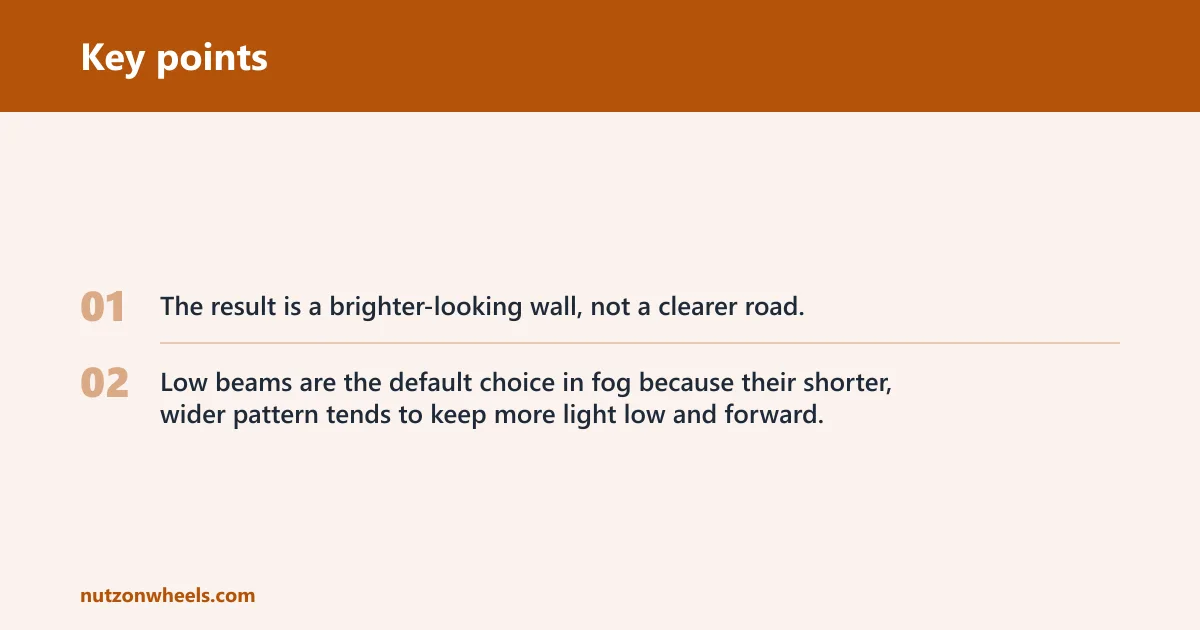
Think of fog as a cloud in the lane. When the beam is aimed farther and higher, it hits more droplets above and ahead of the road surface, then bounces some of that light right back into your eyes. The result is a brighter-looking wall, not a clearer road.
That is why the problem is not raw brightness alone. Beam pattern matters more than brightness in fog, because the cut-off line, beam height, and width-versus-distance tradeoff decide whether the light reaches the pavement or just turns the fog into glare.
Why more light can mean less usable sight distance
High beams are the most powerful setting on vehicle headlights, and they can illuminate up to 500 feet or more according to one guide. In fog, that extra reach often works against you, because the farthest light is the light most likely to scatter back before it reaches the road surface.
Low beams are the default choice in fog because their shorter, wider pattern tends to keep more light low and forward. That makes lane markings, road edges, and the car ahead easier to place without flooding the air above the hood with glare.
Do high beams help in fog?
Usually, no. High beams may seem brighter, but in fog they often reduce usable vision by creating backscatter, so the driver sees more glow and less road. A rare exception is very light mist with no other traffic, yet even then low beams are usually the safer first choice.
When brighter headlights still fail to help
Brighter light only helps if it reaches a useful surface and returns a clean image. In fog, that clean return is often lost because droplets scatter the beam in multiple directions. You may notice the lane line closest to the hood disappear first, while the area directly ahead turns white.
Kia says high beams in fog can reduce visibility by reflecting light back, and Kia recommends low beams instead of high beams in fog, rain, or snow. That matches the driving problem most people notice: the headlights look stronger, but the road picture gets worse.
What the driver actually sees through fog
A common first-timer mistake is assuming the strongest setting gives the longest reach. Picture a two-lane road in light fog: with high beams on, the sign posts and fog in front of the car may glow, but the pavement beyond the hood line can become harder to read than it was on low beams.
That is why beam height matters so much. High beams throw light higher and farther; low beams stay lower and wider. In fog, lower and wider is usually the better trade because it helps with the road edge more than the air above it.
Low beams vs. high beams in fog
Low beams are usually the correct setting in fog because they spread light in a shorter, wider pattern and limit glare from water droplets. High beams reach farther on open roads, but that distance advantage disappears when the air itself becomes the obstacle. Fog changes the job the headlights have to do.
Beam height and cut-off line
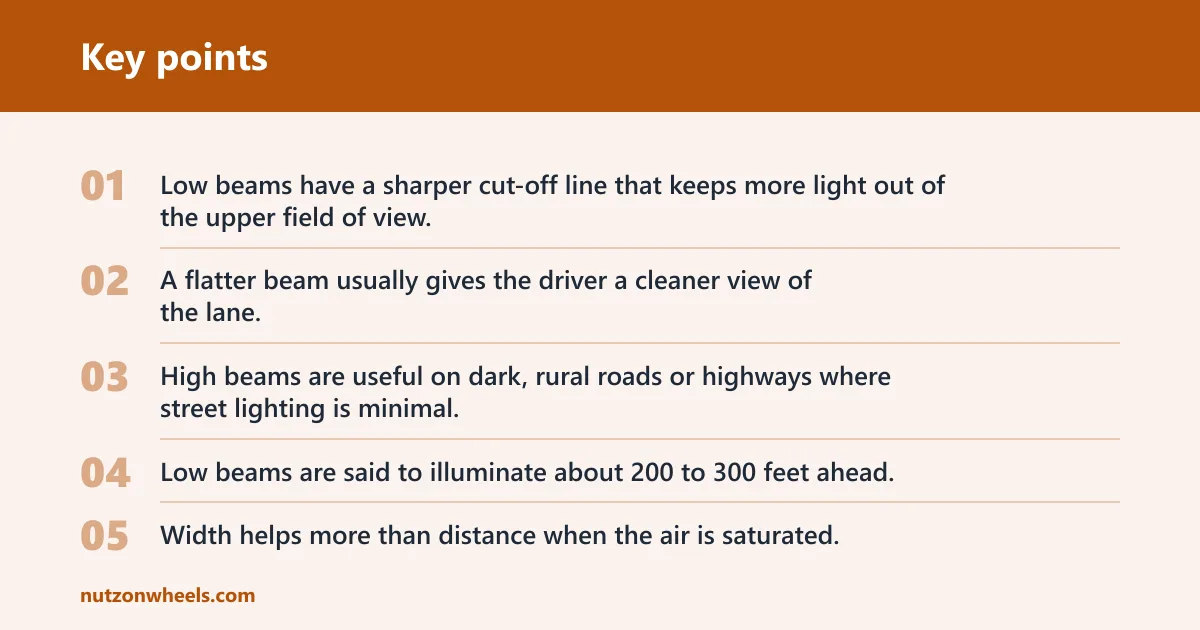
Low beams have a sharper cut-off line that keeps more light out of the upper field of view. That matters in fog because the higher part of the beam is the part most likely to hit suspended moisture and come back as glare. A flatter beam usually gives the driver a cleaner view of the lane.
High beams are useful on dark, rural roads or highways where street lighting is minimal. That is a different situation from fog. On a clear night, distance matters most; in fog, the first goal is reducing reflected glare and preserving contrast near the road surface.
Width versus distance in reduced visibility
Low beams are said to illuminate about 200 to 300 feet ahead. That shorter reach is often enough in fog because the problem is not how far the headlight can throw light, but how much useful detail returns from the roadway. Width helps more than distance when the air is saturated.
Suppose fog thickens from a light haze to a visible wall over a few hundred yards. The correct move is not to “get more power” from the headlights. It is to keep the beam low, slow down, and decide whether the road ahead is still visible enough to continue safely.
Why low beams are usually the default
Low beams are the default choice in fog and other low-visibility conditions because they reduce back-glare and help you see the lane edge without lighting the air too much. They also work better around other traffic, where high beams can dazzle oncoming drivers or the mirror of a vehicle ahead.
Even when a road feels empty, the legal and safety rules still favor low beams once visibility drops. Reduced visibility can require headlights whenever you cannot clearly see ahead, and many states require headlights whenever wipers are running in rain or snow.
Fog lights and why they are different
Fog lights are built for a fog beam pattern rather than long-range reach. They are usually mounted low and aimed with a flatter beam that can reduce back-glare compared with high beams. They do not replace careful speed control, but they can help when fog is light enough to keep moving.
Low mounting and flatter beam pattern
The lower mounting point matters because it keeps the beam below much of the fog layer that hangs in the driver’s line of sight. A low-mounted lamp also tends to send less light upward, which lowers the amount of glare bouncing back from droplets.
Fog lights are sold with beam type listed as fog. Some fog lights on the product page are E-mark certified. That does not make them a cure-all, but it does show they are designed and labeled for this kind of use rather than for long-distance high-beam work.
Where fog lights fit in a fog-lighting setup
Fog lights work best as part of a simple hierarchy: use low beams first, add fog lights if your vehicle has them and local rules allow them, and keep high beams off in dense fog. They are an aid for road-edge visibility, not a license to drive faster.
They also matter less than many drivers expect when fog gets truly heavy. In dense fog, even a correct beam pattern can only do so much, because the limiting factor becomes the air itself. At that point, stopping is often the safer choice.
When should you switch lights as fog thickens?
Switch as soon as the beam starts producing glare instead of detail. Light fog may allow low beams and fog lights; moderate fog usually calls for low beams only; dense fog often means pulling over until visibility improves. The rule is simple: if you cannot see clearly ahead, lower the light output and reassess.
Light fog
In light fog, low beams are usually enough. If the car has fog lights, they can help with lane edge and shoulder detail, especially on roads with no street lighting. Keep the speed down so your stopping distance matches the visible road.
Moderate fog
Moderate fog is where many drivers make the wrong trade. High beams feel stronger at first, but the reflected haze often becomes more obvious within seconds. Stay on low beams, and use fog lights only if they improve contrast without creating extra glare.
Dense fog and pull-over conditions
Dense fog means the beam is no longer doing enough useful work. If you cannot clearly see ahead, pull over in a safe place and wait for visibility to improve. A headlight cannot fix a white-out view, and forcing the issue can make lane position and braking distance harder to judge.
Fog lighting decision matrix
The best light choice depends on visibility distance, not just on whether the headlights look bright. Use this simple matrix to match the beam to the road. If conditions change quickly mile by mile, repeat the check each time the fog thickens or opens up.
| Visibility on the road | Best light choice | What to expect |
|---|---|---|
| Clear enough to see ahead without strain | Low beams | Normal low-visibility driving; keep speed appropriate |
| Light fog with lane lines still visible | Low beams; fog lights if equipped and allowed | Better road-edge contrast with less back-glare |
| Moderate fog with glare starting | Low beams only | High beams are more likely to reflect light back at you |
| Dense fog, white-out glare, or unclear road ahead | Pull over | Driving becomes unsafe even with the right beam pattern |
Use this rule with the legal visibility trigger in mind. Visibility distance is the practical trigger for the light choice, since many laws commonly use distance thresholds such as about 500 feet or 1,000 feet for reduced-visibility driving. When visibility gets close to those limits, treat the situation as a lighting problem and a stopping problem.
Is it illegal to use high beams in fog?
Not always, but it can be restricted by local rules and by the presence of other traffic. Many laws focus on reduced visibility and the need to dim for other vehicles. In fog, the safer answer is usually low beams, with high beams reserved for conditions where they do not create glare or blind other drivers.
Reduced-visibility laws and visibility-distance thresholds
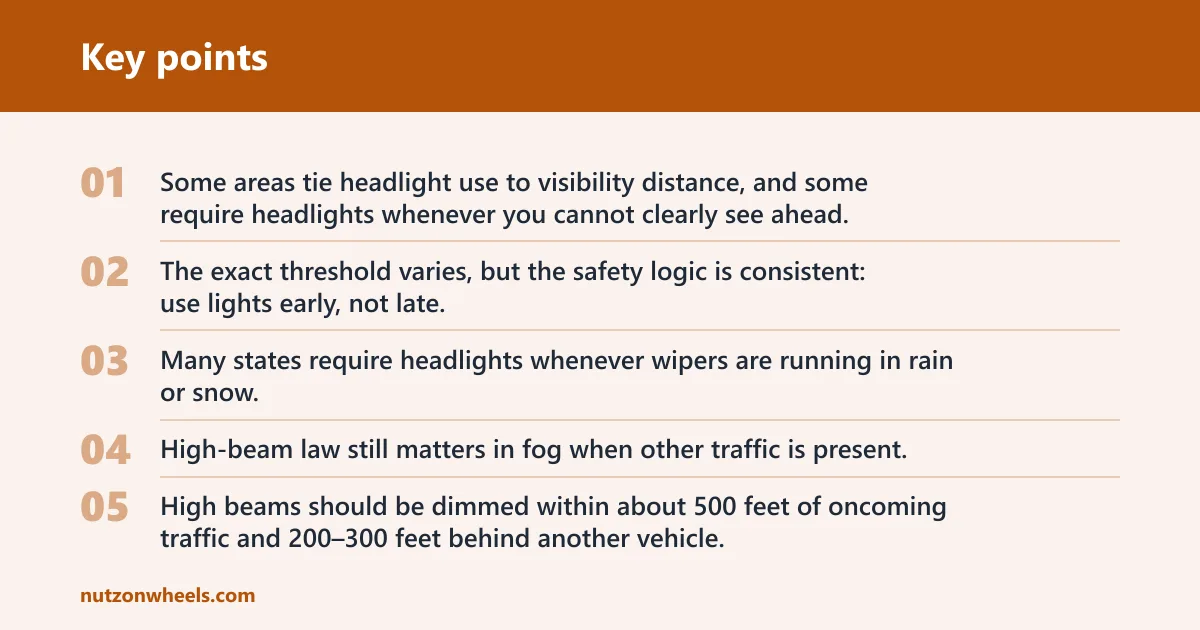
Some areas tie headlight use to visibility distance, and some require headlights whenever you cannot clearly see ahead. That means fog can trigger the same headlight-on rule that applies in other low-visibility conditions. The exact threshold varies, but the safety logic is consistent: use lights early, not late.
Many states require headlights whenever wipers are running in rain or snow. That is not a fog rule by itself, but it shows how quickly visibility-based rules can change once weather reduces what the driver can see.
High-beam dimming rules near other traffic
High-beam law still matters in fog when other traffic is present. High beams should be dimmed within about 500 feet of oncoming traffic and 200–300 feet behind another vehicle. Those rules can apply regardless of whether the road is clear or foggy, and state-by-state variation still matters.
So, even if a driver thinks the road is empty, a quick check for headlights in the distance and taillights ahead is still necessary. Fog makes that scan harder, which is another reason low beams are the safer default.
Why state rules can differ
Some states write the rule around distance from other vehicles; others use a broader reduced-visibility standard. That is why the legal answer is not a blanket yes or no. The practical answer is simpler: if fog is reducing sight distance, low beams are the safer and more defensible choice.
What to do when visibility drops fast
When fog thickens quickly, reduce glare first, then reduce speed, then decide whether to stop. High beams are the first thing to switch off because they often make the glare worse. If the road picture keeps shrinking, pull over before the lane edge disappears.
Switch to low beams. Turn off high beams immediately if they are on. If the vehicle has fog lights and local rules allow them, add them only if they improve contrast without adding white glare.
Slow down smoothly. Match speed to the distance you can clearly see. If you cannot see far enough to stop in the visible space ahead, the lighting problem has become a stopping problem.
Check for white-out signs. Watch for lane lines fading, headlights reflecting in the fog, and the hood line becoming the only clear reference. Those are failure signs, not reasons to keep pushing forward.
Pull over if needed. Move to a safe shoulder, parking area, or turnout if visibility drops to the point where lane position is uncertain. Parking is safer than trying to out-run the fog with brighter lights.
Say your road starts with mild mist and then drops into a denser patch over the next half mile. If the high beams suddenly make the lane glow white and the taillights ahead look hazy instead of sharp, switch to low beams at once and decide whether the fog is still safe to drive in.
Another common case: a driver reaches an open highway where street lighting disappears, then fog rolls in low over the pavement. High beams might seem logical there, but the lower beam usually keeps the road edge clearer and cuts the reflected glare that hides hazards.
Frequently asked questions
Why are high beams bad in fog?
High beams are bad in fog because they send more light into suspended water droplets, and those droplets scatter the light back toward the driver. That creates glare and reduces usable sight distance, even if the headlights look stronger. Low beams usually give a cleaner road picture.
What lights should you use when driving in fog?
Use low beams first. If the vehicle has fog lights and local rules allow them, they can help in light to moderate fog because their low-mounted, flatter beam is commonly used to reduce back-glare. If visibility keeps falling and you cannot clearly see ahead, pull over instead of relying on brighter lights.
When should you switch from high beams to low beams in fog?
Switch as soon as the beam starts producing glare or the road picture gets less clear. In fog, earlier is usually better.
Do fog lights work better than high beams in dense fog?
Fog lights can work better than high beams in light or moderate fog because they sit low and send a flatter beam. In dense fog, though, even fog lights may not be enough. If visibility drops to the point where you cannot clearly see ahead, pull over.
How does fog make headlights reflect back at you?
Fog contains tiny water droplets that scatter light in many directions. When a beam is aimed high or powerful enough to light up more of the fog, some of that light comes straight back into the driver’s eyes. That reflected light reduces contrast and makes hazards harder to pick out.