What Speed Is Safe for Driving in Heavy Rain on Highways?
On a highway in heavy rain, slow to about 35–45 mph if visibility stays clear and water is shallow; cut speed further, and stop if standing water, spray, or tire condition make control uncertain. Wet pavement lengthens braking distance, raises hydroplaning risk, and can turn a lane change into a crash. This guide gives a real-time speed rule based on visibility, water depth, spray, and tire condition, plus when to slow more or pull off.
How visibility and traction set your speed
There is no single safe highway speed in heavy rain. The right speed is the one that matches what you can see, how much water is on the pavement, how much spray is around you, and how much tread your tires still have. If any of those worsen, the safe speed drops below the posted limit.
Why there is no fixed number
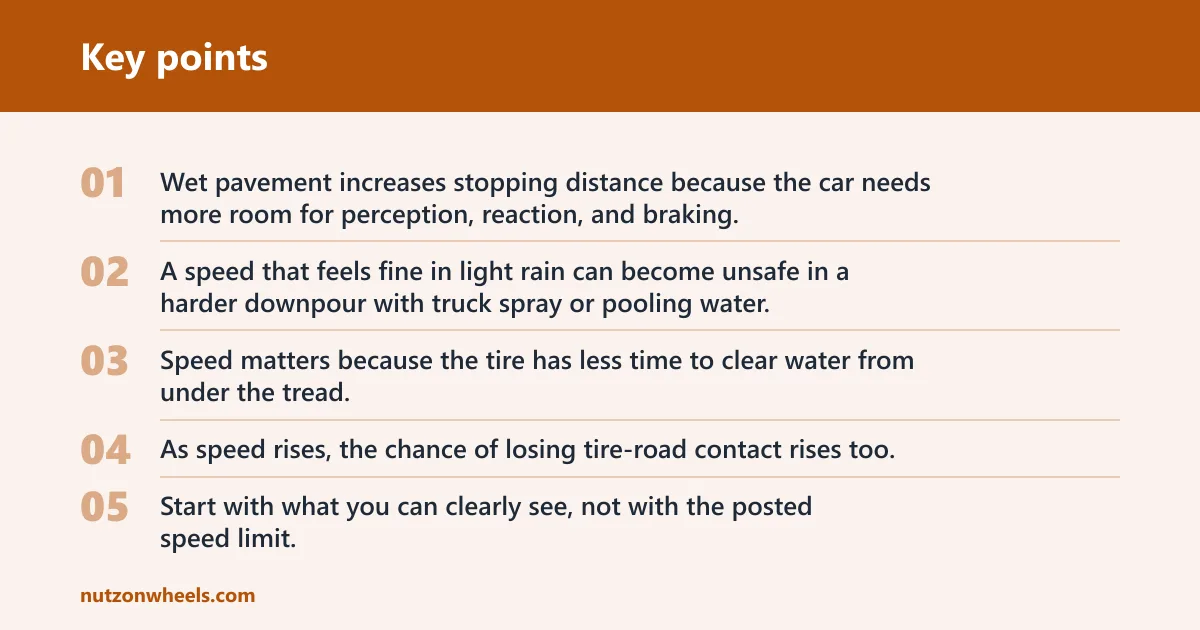
Wet pavement increases stopping distance because the car needs more room for perception, reaction, and braking. It also raises hydroplaning risk, especially as speed climbs and tread wears down. A speed that feels fine in light rain can become unsafe in a harder downpour with truck spray or pooling water.
Speed matters because the tire has less time to clear water from under the tread. As speed rises, the chance of losing tire-road contact rises too. Hydroplaning can begin before the driver feels a full loss of control, which is why waiting for the car to slide is too late.
How visibility and traction set the limit
Start with what you can clearly see, not with the posted speed limit. If you cannot read lane markings, judge the space ahead, or see through truck spray, your speed is too high for the conditions. Headlights and wipers help, but they do not fix a road that is flooding or a windshield that is fogging up.
Traction sets the other limit. Shallow wet pavement usually calls for moderate slowing. Standing water, deep ruts, or worn tread call for a much larger drop in speed, because the tire has less grip and less ability to cut through the water film.
Heavy-rain highway speed rule
Use this general rule on the highway: if visibility is clear and water is only a wet film on the pavement, stay in about the 35–45 mph range and leave extra room. If spray is heavy or lane markings are hard to follow, drop below that range. If water is pooling, slow much more or get off the road.
The posted limit is not automatically safe in heavy rain. It may be too fast even when traffic is moving normally, and it becomes riskier when adjacent lanes send up spray or when drainage is uneven across the roadway.
Rain speed decision table
| Condition | Recommended speed band | Why this band fits | Stop-driving trigger |
|---|---|---|---|
| Clear visibility, light spray, shallow wet pavement, normal tread | 35–45 mph | Leaves more room for braking and lane changes while keeping hydroplaning risk lower than at highway speeds near the limit | Visibility drops enough that lane markings or vehicles ahead are hard to track |
| Reduced visibility, moderate spray, shallow wet pavement, normal tread | 25–35 mph | Compensates for longer reaction time and the extra space needed to judge traffic, runoff, and lane edges | Spray or glare makes it hard to see three to five seconds ahead |
| Clear visibility, heavy spray from trucks, shallow wet pavement, normal tread | 25–35 mph | Spray can hide lane markings and nearby vehicles, so speed should match what you can clearly see and react to | You cannot keep your lane without drifting or making abrupt corrections |
| Any visibility with standing water or deep ruts | Below 25 mph, or pull off if water is deep | Lower speed helps the tire cut through water film and reduces the chance of hydroplaning | Water reaches the curb lane, splashes high, or the car begins to float or wander |
| Reduced visibility, heavy spray, worn tread | Below 25 mph | Worn tread reduces the margin before aquaplaning begins, so the safe speed drops faster than it does with new tires | Tread is near the legal minimum, the car feels light, or steering response becomes vague |
| Standing water plus worn tread | Pull over | Water depth is hard to judge at highway speed, and worn tires lose the cushion that helps them channel water away | Any repeated hydroplaning, or water deep enough to splash over lane stripes |
How much should you slow down on the highway in heavy rain?
Slow enough that you can stop, steer, and see without guessing. For many drivers, that means 10 to 20 mph below the posted limit in heavy rain, and more if spray, pooling water, or worn tread are part of the picture. If conditions keep worsening, the right response is a bigger speed cut or a pull-off.
Use speed bands instead of one target
A fixed target misses the biggest hazard: conditions change fast on a highway. One mile may have clear pavement, while the next has a flooded right lane, a truck throwing spray, and a fogged windshield. Speed bands make you react to the conditions you actually have.
Set your starting pace. Begin below the posted limit before the rain gets heavy. If the road is simply wet and traffic is light, the 35–45 mph range is a cautious starting point.
Check your view ahead. If you cannot see lane markings, taillights, or the pattern of spray from traffic ahead, slow further. Visibility should cap your speed before traction problems do.
Watch the pavement texture. Puddles, ruts, and darker patches signal water buildup. When water begins to pool, cut speed sharply because hydroplaning risk rises quickly and water depth is difficult to judge.
Reassess after every pass. Trucks, SUVs, and lane changes can change spray and drainage in seconds. If the lane gets worse, your speed should follow it down.
Say your car is in the right lane at 42 mph, the rain is heavy, and you can still see the stripes. Then a box truck passes and throws a curtain of spray that hides the next two car lengths. That is a signal to slow below your current pace, not to hold the same speed and hope the spray clears.
When the posted limit is still too fast
The speed limit is still too fast when you cannot stop within the space you can see, when the car starts to feel light over wet patches, or when traffic density forces frequent braking. Heavy rain adds a margin that dry-road driving does not need. Speed reduction is the fastest way to shrink total stopping distance.
Wet-road stopping distance is longer than many drivers expect because the total includes perception, reaction, and braking distance. If the car ahead brakes hard, you need more room to notice it, respond, and stop without a skid. A larger gap is safer than a quick lane change in poor visibility.
How far behind other cars should you stay in heavy rain?
Stay farther back than you would on a dry road, and use a time gap rather than car lengths. In heavy rain, a 4-second gap is a better baseline than the usual lighter-weather spacing, and 5 to 6 seconds is better behind trucks or in heavy spray. More space gives you room to see, brake, and avoid sudden water patches.
Why spray changes your following gap
Spray does more than blur your windshield. It hides brake lights, lane stripes, and the texture of standing water ahead. That means you need more time to read the road and more room to stop if the vehicle ahead hits a wet patch or slows for traffic.
A common first-timer mistake is to shorten the gap because traffic is moving at the same speed. That feels tidy in the lane, but it leaves no cushion when the car ahead hits a deeper puddle or brakes for a visibility problem you have not seen yet.
Extra space behind trucks and SUVs
Large vehicles throw more spray and can block your view of lane markings and drainage changes. They also send water across a wider area of the road. If you are behind one, move back enough that you can see the rear tires and the road surface around them, not just the back door.
If a truck’s spray makes the windshield hard to clear, the following gap is too short. Drop back until the spray no longer dominates your view. That is often more effective than trying to match the truck’s speed at close range.
When should you pull over?
Pull over when visibility falls to the point that you cannot safely track the lane, when hydroplaning happens more than once, or when standing water keeps appearing in your path. The safest move is to leave the roadway and wait it out in a legal, protected place off the travel lane, not on the shoulder if it is unsafe.
Low visibility as a stop signal
If headlights and wipers cannot restore a clear view of lane markings, traffic, and road spray, continued travel is unsafe. Fogging and glare can be worse than the rainfall itself, especially at night or under bright headlight reflections. When the view is gone, speed control is no longer enough.
Signal early. Use turn signals before moving toward an exit or safe stopping area. Early signaling gives following drivers time to adjust in the spray and glare.
Move off the travel lane. Exit the roadway or reach a safe parking area if one is available. Do not stop in an active lane just because traffic has slowed.
Set your hazard lights. Turn them on once stopped if the vehicle is visible and it helps other drivers see you. Use judgment, because hazard lights do not make an unsafe stopping spot safe.
Wait for conditions to improve. Heavy rain can create sudden pooling and low visibility over a short distance. It is better to wait than to keep driving when the road can no longer be read with confidence.
Frequent hydroplaning and pooling water
Repeated hydroplaning is a stop signal, not a warning to keep pushing through. Hydroplaning can start before a full slide, and the next patch of standing water may be deeper than the last. If the steering feels vague, the engine revs rise without forward bite, or the tires skim over water, slow immediately and leave the highway.
Suppose a sedan is traveling at 30 mph in the left lane when the road dips and water pools across the outer lane. If the car begins to drift with little steering response, the safest move is to reduce speed gently and get to a safe exit or pull-off point. Hard braking or a sharp lane correction can make the loss of contact worse.
How to handle hydroplaning if it starts
Ease off the accelerator, keep the steering wheel pointed where you want to go, and avoid hard braking. Sudden inputs can break the tire’s remaining grip. Once the tires regain contact, slow further before resuming normal steering. If it keeps happening, the road is too wet for continued travel at that speed.
Frequently asked questions
What speed is safe for driving in heavy rain on highways?
There is no universal safe number, but a cautious starting range is 35–45 mph when visibility is clear and water is only shallow on the pavement. Slow further if spray builds, visibility drops, traffic is dense, or your tires are worn. If water pools or control feels uncertain, pull off.
Is the speed limit still safe when it’s raining hard?
No. The posted limit is set for normal conditions, not for heavy spray, standing water, or reduced visibility. Wet pavement increases stopping distance and hydroplaning risk, so the safe speed is often below the limit. If the road surface or visibility keeps worsening, even that lower speed may be too high.
What speed should I use if water is pooling on the highway?
Pooling water calls for a sharp speed reduction, often below 25 mph, and a stop if the water is deep enough to splash over lane stripes or make the car feel light. Water depth is hard to judge at highway speed, so the safer response is to slow early or leave the roadway.
Does speed change if I have all-season or rain tires?
Yes, but only to a point. Better tires can help channel water, yet they do not make high speed safe in heavy rain. Tread depth still matters, and worn tires lose margin quickly. Even with good tires, visibility, spray, and standing water should still control your speed choice.
What should I do if my car starts hydroplaning in heavy rain?
Lift off the accelerator, keep the steering smooth, and avoid hard braking. Let the tires regain contact before making larger corrections. If hydroplaning happens more than once, the rain, water depth, or speed is too much for the road, and you should get off the highway.