What Is the Most Common Distraction for Teen Drivers?
Phone use is the most common distraction for teen drivers, especially texting and messaging. If a driver looks away for 5 seconds at 55 miles per hour, the car can travel the length of a football field. That short lapse can turn a routine drive into a crash, a ticket, or a lost license. This guide ranks the top teen-driving distractions and gives parents clear rules before solo driving.
Teen distraction table
| Distraction type | Why it is dangerous | When it tends to happen | Parent rule to use first |
|---|---|---|---|
| Texting and messaging | It pulls eyes off the road, hands off the wheel, and attention off traffic at the same time. | At stoplights, in slow traffic, or whenever a notification appears. | Cell phones stay out of reach and off-limits while the car is moving. |
| Other phone app use | Navigation, music, social apps, and scrolling can still create visual and mental distraction. | When a teen tries to search, tap, or adjust an app on the move. | Set the route and audio before shifting into gear. |
| Teen passengers | Peers can create talk, laughter, pressure, and sudden behavior that competes with driving focus. | On the first unsupervised trips, or when friends ride along after school or events. | Start with no passengers unless state law and the parent agreement allow them. |
| Loud music and audio changes | Noise can mask sirens, horns, and other warning cues, while fiddling with controls takes attention away. | When music is turned up, changed often, or used to cover up passenger chatter. | Keep audio low and preset before departure. |
| Eating or drinking | Hands leave the wheel and attention shifts to spills, wrappers, or drinks. | During short trips, school commutes, or practice drives when the teen thinks the route is easy. | No eating or drinking while driving until safe habits are established. |
What is the most common distraction for teen drivers?
The most common distraction for teen drivers is usually phone-related behavior, especially texting and messaging. That answer is more specific than “phones” in general. It points to the behavior most likely to combine visual distraction, manual distraction, and cognitive distraction in one action.
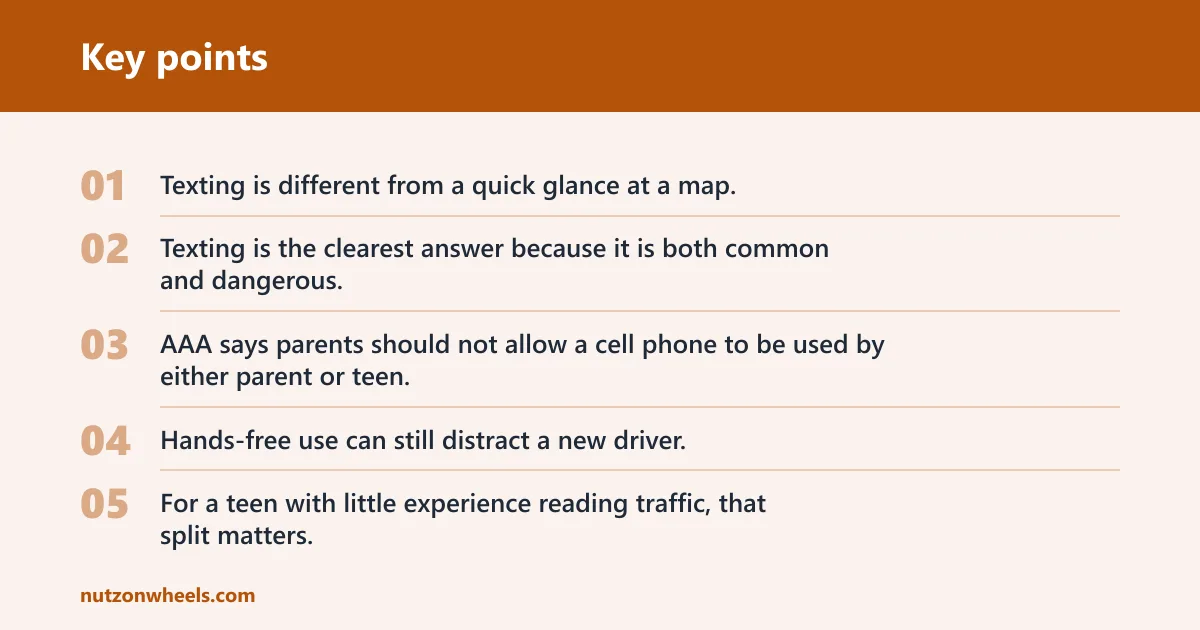
Texting is different from a quick glance at a map. It usually means looking down, holding the phone, and thinking about a message instead of traffic. Safer America says texting is the most common instance of distracted driving on roads, and it says teenagers are the most susceptible to texting and driving.
Why texting rises to the top
Texting is the clearest answer because it is both common and dangerous. The same source says sending one text message takes eyes off the road for about five seconds, and at 55 miles per hour a driver can travel the length of an entire football field in that time.
That matters most for teens because they are a high-risk novice driver group. They have limited experience, weaker hazard judgment, and more exposure to peer influence. They are also more likely to use smartphones while driving than many older drivers.
How phone use fits the answer
Phone use is broader than texting. It includes messaging, app interaction, music control, and navigation. Those tasks may not all be as risky as composing a text, but they still pull attention away from the road and can create the same chain of mistakes: eyes down, hands busy, mind off driving.
That is why a parent rule should treat the phone as a category, not only a texting device. AAA says parents should not allow a cell phone to be used by either parent or teen. That rule is strict, but it gives a clear baseline before solo driving. (AAA)
Why phones still matter when hands-free
Hands-free use can still distract a new driver. A voice command, a navigation prompt, or a speakerphone conversation may keep both hands on the wheel, but it can still split attention and slow reaction time. For a teen with little experience reading traffic, that split matters.
Picture a newly licensed driver trying to find a store while a passenger asks for a playlist change and the navigation app speaks over both. Nothing looks like a dramatic mistake at first. Then the driver misses a lane change, checks the screen, and drifts toward the edge line.
Why teen drivers get distracted so easily
Teen drivers are easier to distract because they are still building basic driving judgment while also learning how to manage traffic, speed, spacing, and timing. That leaves less mental room for anything extra. Phones, passengers, and music all compete with the same limited attention.
Peer pressure adds another layer. A teen may feel pushed to answer a text, join a group chat, or keep the music loud to match the mood in the car. Those social cues can be stronger in the first months of solo driving, when confidence is still developing.
Inexperience and split attention
New drivers do not yet scan the road as automatically as experienced drivers. A small distraction can break a chain of basic checks: mirror, speed, lane position, space ahead. Once that chain breaks, the mistake can snowball into a lane drift, a hard brake, or a missed hazard.
Distraction matters because it comes in three forms. Visual distraction means eyes leave the road. Manual distraction means hands leave the wheel. Cognitive distraction means the mind is on something else. Texting hits all three at once, which is why it sits at the top of the list.
Peer pressure and passenger talk
Passengers can increase distraction through jokes, arguments, sudden directions, and the pressure to “just check” a phone. That risk is higher when the driver is newly licensed and still learning how to ignore noise in the cabin. A calm passenger can help; a rowdy one can undo a safe trip fast.
AAA says other teen passengers are one of the most dangerous sources of distraction for teen drivers. That does not mean every passenger is a crash risk. It means teen passengers deserve a serious place in the parent rule set, especially early on.
Phones, music, and routine habits
Routine can create false confidence. A teen may think a familiar route, a short trip, or a favorite playlist makes distraction harmless. It does not. The same phone tap or music change that seems minor at home can become a problem when traffic shifts suddenly.
Say your teen is driving home after practice with the volume up and a friend in the back seat. The friend asks for a song change, the driver reaches for the screen, and a red light turns into a last-second brake. The issue is not the song. It is the attention that moved away from driving.
Are teen passengers the biggest distraction?
Teen passengers are one of the biggest distractions for new drivers, but they are not the only answer to this question. For many teens, the phone is still the most common distraction. Passengers become especially risky when they add noise, pressure, or behavior that makes the driver look away or think less clearly.
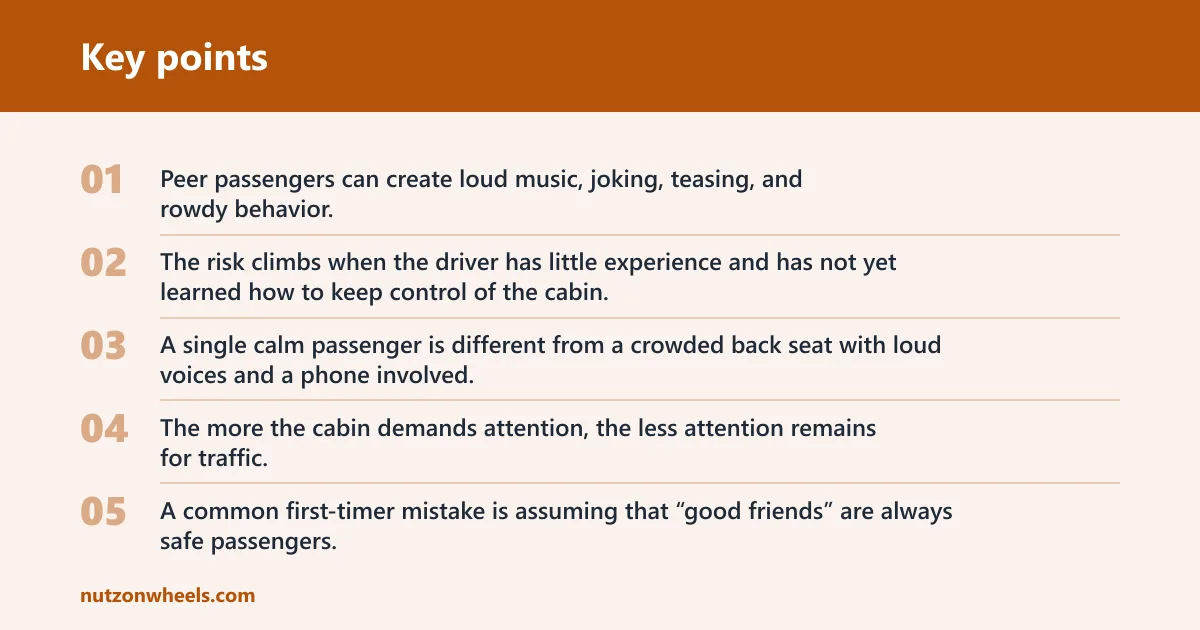
Peer passengers can create loud music, joking, teasing, and rowdy behavior. They can also make a teen feel watched, which can lead to faster driving or poor decisions. The risk climbs when the driver has little experience and has not yet learned how to keep control of the cabin.
When passengers become a problem
Passengers are most likely to cause trouble when the driver is newly licensed, the route is unfamiliar, or the car is full. A single calm passenger is different from a crowded back seat with loud voices and a phone involved. The more the cabin demands attention, the less attention remains for traffic.
A common first-timer mistake is assuming that “good friends” are always safe passengers. Even friendly banter can become a distraction if it pulls the driver into a conversation at the wrong time, such as a merge, a left turn, or a school-zone slowdown.
Which behaviors raise the risk most?
The riskiest passenger behaviors are the ones that change what the driver is doing right now. That includes grabbing the phone, shouting directions, laughing over the driver’s concerns, or encouraging risky choices. Peer pressure is especially dangerous because a teen may follow the group instead of the road.
Passenger-related risk is also tied to state law. Graduated driver licensing rules can vary by state and may limit passenger counts, phone use, or both. Those rules are a good baseline, but parents can be stricter than the state minimum.
How passenger limits help new drivers
Passenger limits reduce noise, pressure, and sudden behavior during the period when a teen is still learning. That is why many parents keep the first solo trips very simple. No crowd. No phone. No extra tasks.
AAA recommends strict distraction rules before a teen drives solo. That should include a clear passenger plan, because the cabin gets more complex as soon as friends get in the car.
A practical ranking helps parents decide what to ban first. Start with anything that combines visual, manual, and cognitive distraction. Then move to lower-level distractions that still matter, such as music changes or eating. The order matters because not every distraction carries the same risk.
Visual distraction
Visual distraction is anything that takes the eyes off the road. Texting is the clearest example, but so are screen taps, scrolling, and looking down to change settings. A teen cannot see traffic hazards while staring at a phone or a menu screen.
Manual distraction
Manual distraction means hands leave the wheel. That includes holding a phone, unwrapping food, or reaching back to quiet a passenger. A hand off the wheel matters even more when the driver also needs to brake or steer around a sudden hazard.
Cognitive distraction
Cognitive distraction happens when the mind is busy with something other than driving. A phone conversation, an argument, or a stressful message can keep attention away from the road even if the driver is still looking forward. That delay can matter just as much as a head-down glance.
Here is the simplest order for parents: ban texting and other phone use first, limit passengers next, then set rules for music, food, and any other in-car activity that pulls attention away from driving.
What should parents do before solo driving?
Parents should set a parent-teen driving agreement before solo driving begins. That agreement should spell out no-phone rules, passenger limits, music limits, and what happens if the teen breaks the rules. Clear consequences work better than vague warnings because the driver knows exactly what is expected.
Parents should also use state graduated driver licensing rules as the minimum standard. Those rules can limit passengers and phone use, but they differ by state. The safest family plan is often stricter than the law, especially during the first months of independent driving.
Set a parent-teen driving agreement
Write the phone rule first. Put cell phone use off-limits while the car is moving, including texting, messaging, scrolling, and app use. AAA says parents should not allow a cell phone to be used by either parent or teen.
Set passenger limits. Start with the fewest passengers possible, then add them only after the teen shows steady judgment. If state law is stricter, use the state rule.
Define music and food limits. Keep audio low enough to hear sirens and horns, and do not allow eating or drinking until the teen has stronger habits. The goal is to keep hands, eyes, and attention on driving.
Agree on consequences. If the teen breaks the rule, pause solo driving or reduce privileges. Consequences should be immediate and specific so the rule stays real.
Use state GDL rules as a baseline
Graduated driver licensing is designed to limit risk while teens gain experience. It often includes restrictions on night driving, passengers, and cell phone use, though the details vary by state. Parents should know the local rules before the teen starts solo driving.
Those rules matter because teen drivers are not just younger adults. They are novices. The system is built around that fact, and family rules should be built the same way.
Keep practicing distraction scenarios
Supervised practice driving should continue before solo driving, and AAA says that supervised practice should continue until a teen logs at least 100 hours. That practice should include distraction scenarios, not only parking, turns, and lane changes.
Suppose a teen is asked how to handle a friend reaching for the phone at a red light. The correct answer is to keep driving focused, ignore the grab, and pull over safely if help is needed. Another scenario should cover a music argument, because the safest move is to lower the volume or stop the car if the distraction continues.
Frequently asked questions
What is the most common cause of distracted driving among teen drivers?
Phone use is usually the most common cause, with texting and messaging at the center of it. That includes looking at the screen, typing, tapping apps, and reacting to alerts. Teen passengers matter too, but the phone is the clearest first rule to set because it is both common and highly distracting.
What is the most common form of distraction leading to a teen driving crash?
Texting is the most common form to focus on because it creates visual, manual, and cognitive distraction at the same time. A teen who reads or sends a text is looking away, handling the phone, and thinking about something other than traffic. That combination makes it especially dangerous.
Are teen passengers the biggest distraction for new drivers?
Teen passengers are one of the biggest distractions, especially for newly licensed drivers, but not always the single biggest one. AAA says other teen passengers are one of the most dangerous sources of distraction. The safest approach is to limit passengers and treat the phone as off-limits.
Why do teen drivers get distracted so easily?
Teens are still learning how to scan traffic, judge gaps, and react under pressure. That leaves less room for side tasks like texting, music changes, or passenger talk. Peer influence also matters more for many teens, so social pressure can pull attention away from driving fast.
What should a teen do if friends are distracting them in the car?
The teen should stop the distraction early. That means asking friends to quiet down, refusing any request to handle the phone, and pulling over if the situation does not settle. A good rule is simple: if the cabin is taking over the drive, the car needs to stop.
Can loud music distract a teen driver?
Yes. Loud music can make it harder to hear sirens, horns, and other traffic cues, and changing the music can take attention away from the road. The safer rule is to set audio before driving and keep the volume low enough to stay aware of what is happening outside the car.
Can eating or drinking while driving distract a teen driver?
Yes. Eating or drinking can take one hand, sometimes both hands, away from the wheel, and it can shift attention to spills, wrappers, or cups. For a novice driver, that extra task is rarely worth the risk. A better rule is to finish food before the trip or wait until parked.
What should parents do about distractions before a teen drives solo?
Parents should set a written agreement before solo driving, use state GDL rules as the baseline, and make the phone off-limits. AAA recommends strict distraction rules before solo driving and says supervised practice should continue until at least 100 hours are logged. Keep practicing real distraction scenarios too.