What Are the Unspoken Rules of Courteous Driving in Heavy City

Courteous heavy-city driving means doing three things consistently: leave a full car length at stops, signal every lane change or turn before you need the gap, and hold your lane unless moving clearly helps traffic. Skip those cues and you create braking waves, blocked merges, and near-misses. This guide covers the small, high-signal moves that keep dense stop-and-go traffic predictable.
What courteous city driving really means
Courteous city driving is not about being extra polite. It is about making your next move easy to read so other drivers, pedestrians, cyclists, and bus riders can act without guessing. In heavy traffic, small mistakes spread fast because every gap is short and every delay gets copied by the cars behind you.
Why small signals matter in dense traffic
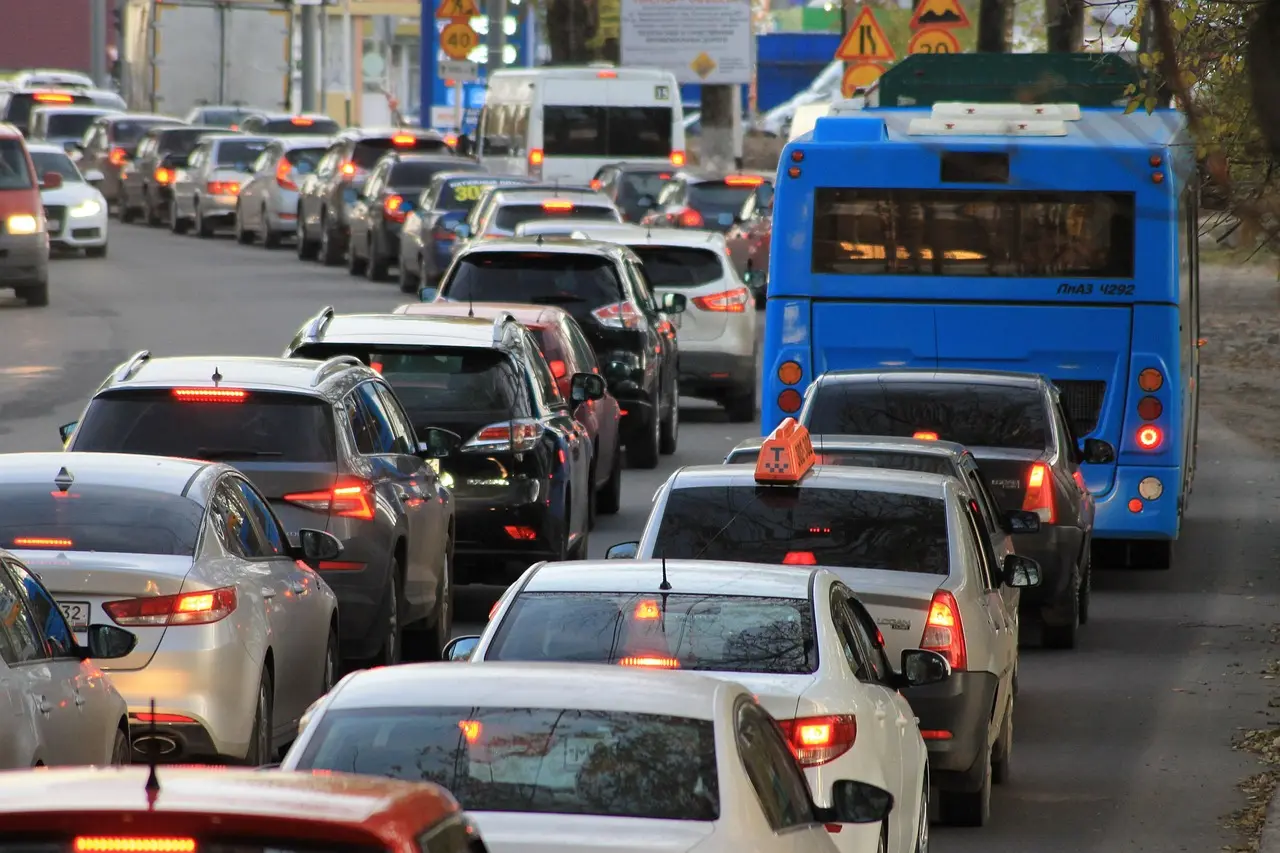
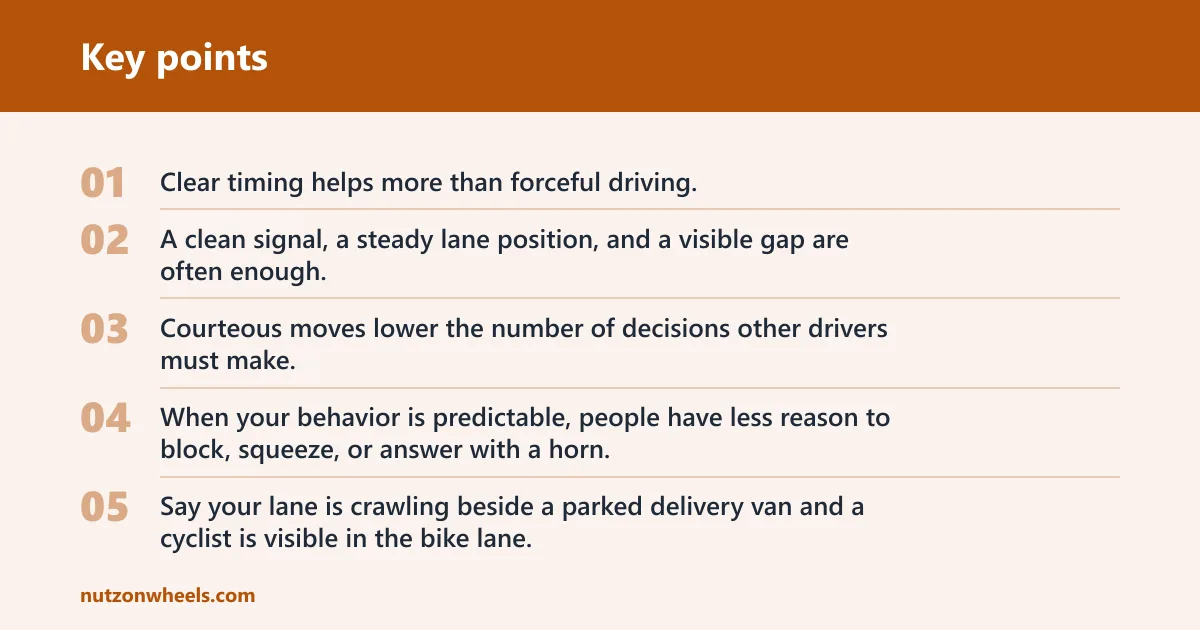
Dense traffic punishes silence. If you drift, brake late, or change lanes without warning, the cars around you must react at the last second, which creates stop-and-go shock waves. Clear timing helps more than forceful driving. A clean signal, a steady lane position, and a visible gap are often enough.
How courtesy reduces confusion and conflict
Courteous moves lower the number of decisions other drivers must make. That matters most where sightlines are poor, speeds are low, and everyone is trying to claim the same inch of pavement. When your behavior is predictable, people have less reason to block, squeeze, or answer with a horn.
Say your lane is crawling beside a parked delivery van and a cyclist is visible in the bike lane. Keep a steady speed, signal early, and wait for a real opening. A sudden swerve tells them nothing.
How weather and vehicle size change the buffer
A common rule of thumb in stop-and-go traffic is to leave enough space to see the rear tires of the car ahead. That gives you a usable buffer if the car stops again. In rain, add more room because braking distances grow and tire spray can hide movement. At night, open the gap further so you can read brake lights and lane position sooner. Behind larger vehicles such as SUVs, vans, trucks, and buses, leave extra space because their size can block your view and make their stops harder to predict.
How do you change lanes politely in heavy traffic?
Change lanes with early, visible intent and one clear gap at a time. Signal before the opening closes, check mirrors and blind spots, and move only when the next driver can see your plan. In stop-and-go traffic, a smooth zipper merge is usually more courteous and safer than trying to force your way ahead.
Use zipper-merge behavior
In a zipper merge, each lane keeps moving until the merge point, then cars take turns one at a time. That is the fairest pattern when lanes narrow or when a lane ends. Do not accelerate to block the other lane, and do not stop early just to “save” space. Both actions slow the line.
- Signal early. Turn on the signal before the gap closes, not after your bumper is already half in the next lane. Early signaling gives the other driver time to release space without hard braking.
- Check mirror and blind spot. Look for motorcycles, scooters, and small cars that can hide beside an SUV or truck. Urban vehicles create large blind spots, so a quick shoulder check still matters.
- Move one car at a time. Enter only a gap large enough for one vehicle. Cutting in front of two cars at once invites brake checking and makes the merge harder for everyone behind you.
Blind spots, mirrors, and size-related visibility
Always assume a motorcycle or scooter can sit where your mirror does not quite catch it. Delivery vans and tall SUVs also hide vehicles in adjacent lanes more easily than sedans do. If your mirror view is uncertain, a brief pause is better than an abrupt move. Polite merging is often just accurate merging.
Intersection and crosswalk rules that prevent confusion
Do not enter an intersection unless you can clear it. Do not stop on a crosswalk. In heavy city traffic, those two rules do more to prevent gridlock than any amount of honking. They keep pedestrians visible, preserve turning space, and reduce the chance that cross traffic gets trapped.
Do not block the box
If the far side of the intersection is full, wait before entering. That is the cleanest way to avoid blocking the box and trapping cross traffic behind you. The rule is simple: only go forward when you have room to finish the move. If the light changes while you are inside, keep clearing the intersection and avoid stopping in the middle.
Never stop on a crosswalk
Crosswalks need a clear path so pedestrians can cross and drivers can see them. If traffic stacks up ahead, stop before the crosswalk line. At intersections with low visibility, this matters even more because a person can step out from behind a tall vehicle or a turning car with very little warning.
Picture a left turn at a crowded downtown corner. If the exit lane is jammed, waiting behind the stop line is slower for a moment, but it prevents a blocked intersection and lets pedestrians see a clean crossing. Entering anyway usually creates more delay, not less.
How should you handle pedestrians and cyclists?
Yield first, then move only after the path is clear. Pedestrians have priority in crosswalks, and cyclists need space because a door opening or a tight turn can cut off their line. In city traffic, the safest courtesy is often simply leaving them room to keep moving without guessing your next move. (Nhtsa)
Pedestrian priority at crosswalks and curbs
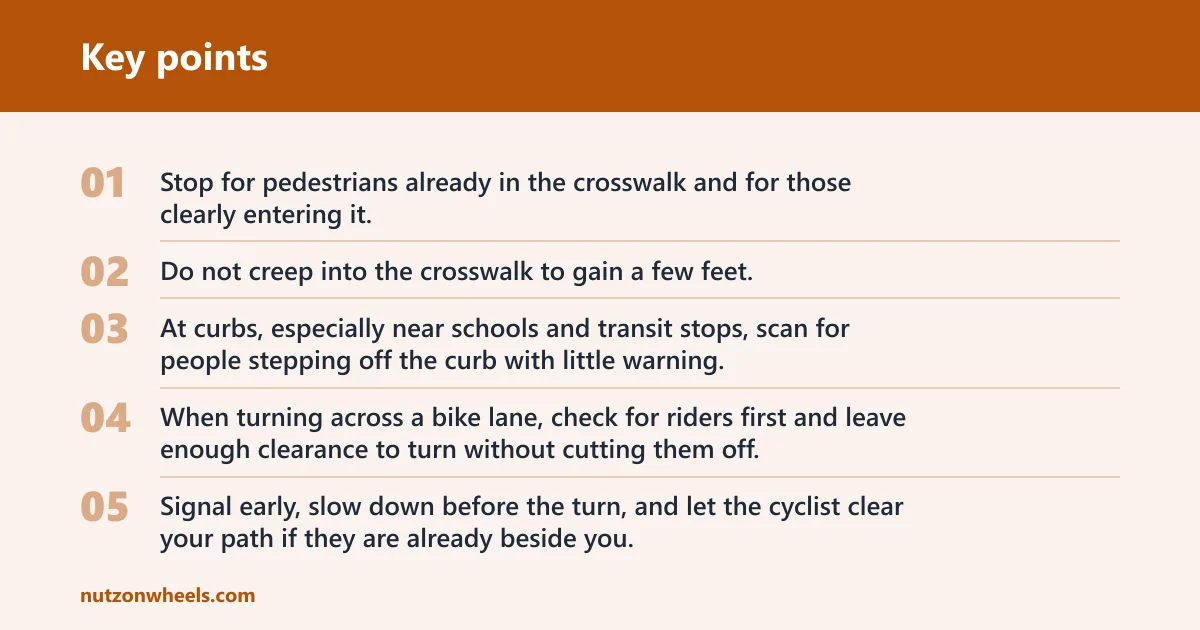
Stop for pedestrians already in the crosswalk and for those clearly entering it. Do not creep into the crosswalk to gain a few feet. That blocks their path and makes you harder to see from the side. At curbs, especially near schools and transit stops, scan for people stepping off the curb with little warning.
Bike lane clearance and dooring risk
Never stop in a bike lane. A parked or idling car in that lane forces cyclists into traffic and raises dooring risk when someone inside the car opens a door into the bike path. When turning across a bike lane, check for riders first and leave enough clearance to turn without cutting them off.
Turning past cyclists without cutting them off
Signal early, slow down before the turn, and let the cyclist clear your path if they are already beside you. Do not swing wide without checking the side mirror and shoulder. If a rider is approaching from behind on the right, wait and turn only after the lane is clear.
When should you use your horn in heavy traffic?
Use the horn as a warning, not as a speech. A short tap is appropriate when another driver, cyclist, or pedestrian may not see you and danger is immediate. Long honking usually adds stress and can make traffic less predictable. If the problem is annoyance rather than danger, the horn is the wrong tool.
What counts as a warning horn
A brief tap is enough to alert someone drifting into your lane, backing into your path, or moving off without noticing you. Keep it short. The goal is to say “look here” and nothing more. If the other person has already seen you, do not repeat it.
Why long honks usually make traffic worse
Prolonged honking often escalates tension and can trigger a worse reaction from a frustrated driver. In heavy congestion, people are already boxed in. Adding a long blast rarely creates space. It usually creates hostility, which makes lane changes, merges, and turns less predictable for everyone nearby.
School zones and bus stops
Expect lower speeds, extra yielding, and more foot traffic near schools and bus stops. Children, caregivers, and passengers may step out from between vehicles. A bus pulling out may also need room to re-enter traffic. Slow down early, leave extra space, and avoid rushing the gap near a bus stop.
City traffic courtesy checklist
This checklist turns the usual courtesy advice into exact actions. Use it as a quick decision aid when traffic is tight and every lane is full of moving, stopping, and changing intentions.
| Scenario | Exact recommended action |
|---|---|
| Merging | Signal early, check mirrors and blind spots, and move one car at a time when a real gap opens. |
| Blocked intersection | Wait outside the box until your exit lane is clear; do not enter if you cannot finish the crossing. |
| Pedestrian at curb | Slow down, yield if the person may enter the crosswalk, and never nose into the walking path. |
| Cyclist on right | Leave the bike lane clear, check the right side before turning, and give the rider full turning space. |
| Double-parked lane | Merge early and smoothly, then signal before you move around the obstacle so others can adjust. |
| Bus pulling out | Slow to let the bus rejoin if needed and avoid crowding its front corner or door area. |
| Taxi stop | Expect sudden curb changes, keep a steady following buffer, and watch for passengers opening doors. |
| Zipper merge | Take turns one car at a time at the merge point instead of forcing a lead or blocking a lane. |
| Emergency vehicle behind | Move right if safe, clear the lane, and avoid stopping in a way that blocks its path. |
| Honk-worthy hazard | Use one short tap only if another road user may not see you and a collision risk is immediate. |
| Slow driver ahead | Hold your lane, maintain space, and wait for a legal, visible passing opportunity rather than crowding. |
| Aggressive driver nearby | Keep extra space, avoid eye contact battles, and let them pass if that lowers tension. |
How do you avoid road rage in crowded traffic?
Avoid road rage by making your moves easy to predict and hard to misread. Leave room, do not tailgate, and do not answer aggression with more aggression. When another driver behaves badly, the safest response is often to create distance and stop feeding the conflict.
Space-forgiving habits that lower tension
Give a little extra room when traffic is dense, especially if the driver ahead is hesitating or changing lanes often. That reduces the need for hard braking and lets traffic breathe. Courtesy in city traffic often means tolerating a small delay so the whole stream stays calmer.
What to do around aggressive drivers
If someone cuts in, crowds your bumper, or leans on the horn, do not block them to prove a point. Let them pass if you can do so safely. A calm exit from the conflict is usually better than trying to win a short argument with a moving car.
When yielding is safer than proving a point
Yield when the other driver is already committed, when the lane is too tight for two vehicles, or when the road ahead is blocked anyway. That is not surrender. It is a way to prevent a small mistake from turning into a crash, a jam, or a confrontation that spreads to everyone behind you.
Frequently asked questions
What are the unspoken rules of driving in heavy city traffic?
The main unspoken rules are simple: signal early, leave room, do not block intersections or crosswalks, and hold steady lane position until a move is clear. In dense traffic, predictability matters more than speed because every unclear move forces someone else to react.
How do I change lanes politely in stop-and-go traffic?
Signal before the gap closes, check mirrors and blind spots, and move only one car at a time into a clear opening. If the lane is ending, zipper behavior is the polite pattern. Trying to force a merge usually slows both lanes and raises tension.
Is it rude to block the intersection in city traffic?
Yes. Entering an intersection without room on the far side can trap cross traffic and turn a normal light cycle into a jam. Wait outside the box until you can clear it. If you are already inside, keep moving through as soon as the path opens.
How do I let pedestrians and cyclists through without causing confusion?
Stop before the crosswalk line, keep bike lanes clear, and signal turns early so people can read your path. Do not creep forward to “help” traffic move. Clear, still positioning is easier to understand than inching into someone else’s space.
How close should I follow another car in heavy traffic?
Leave enough space to see the rear tires of the car ahead. That is a useful minimum in stop-and-go conditions because it gives you room to stop without bumping the bumper in front. Add more space in rain, at night, and behind large vehicles that block your view.