
What Lights Should You Use When Driving in Fog?

Use dipped headlights first in fog on UK roads. Add front fog lights only when visibility is severely reduced, and switch on rear fog lights only when drivers behind genuinely cannot see you. Get it wrong and you can dazzle other road users and risk a lighting offence. This guide gives you a simple UK lighting rule, when to use each lamp, and what the Highway Code expects.
Fog lights in fog
Fog changes what your lights can do. Main beam bounces back from water droplets and can make the view worse, while dipped headlights give you forward light without the same glare. Front fog lights can help in very poor visibility, but they are not a replacement for dipped headlights.
Rear fog lights have one job only: helping traffic behind see you. Leave them on too long and they can dazzle drivers, especially in slower traffic or at night when visibility has improved.
What you’ll need
- Your vehicle’s light switch and instrument panel.
- A clear view of the road ahead and rear mirrors.
- A sense of distance: roughly 100 metres is about a football pitch length.
- Enough time to slow down before visibility drops further.
- Washer fluid and clean windows for better contrast in mist and spray.
Fog light decision table
| Visibility level | Road type | Lights to use | Lights to avoid | When to switch off |
|---|---|---|---|---|
| Light mist, clear lane markings | Urban roads | Dipped headlights | Front fog lights, rear fog lights | Leave fog lights off unless visibility drops sharply |
| Dense fog, visibility around 100 metres or less | Any road | Dipped headlights, front fog lights if fitted | Main beam headlights | Turn front fog lights off as soon as visibility improves |
| Heavy spray from other vehicles | Motorway or dual carriageway | Dipped headlights; rear fog lights only if traffic behind cannot see you | Main beam headlights; front fog lights if spray is only light | Switch off rear fog lights once spray no longer hides the car behind |
| Motorway fog bank | Motorway | Dipped headlights, front fog lights if visibility is severely reduced | Main beam headlights | Switch fog lights off when the fog bank clears |
| Parked roadside in fog | Roadside stop | Sidelights or parking lights if you must stop there | Main beam headlights, fog lights left on | Move to a safer off-road place if possible |
Should you use dipped headlights or fog lights?
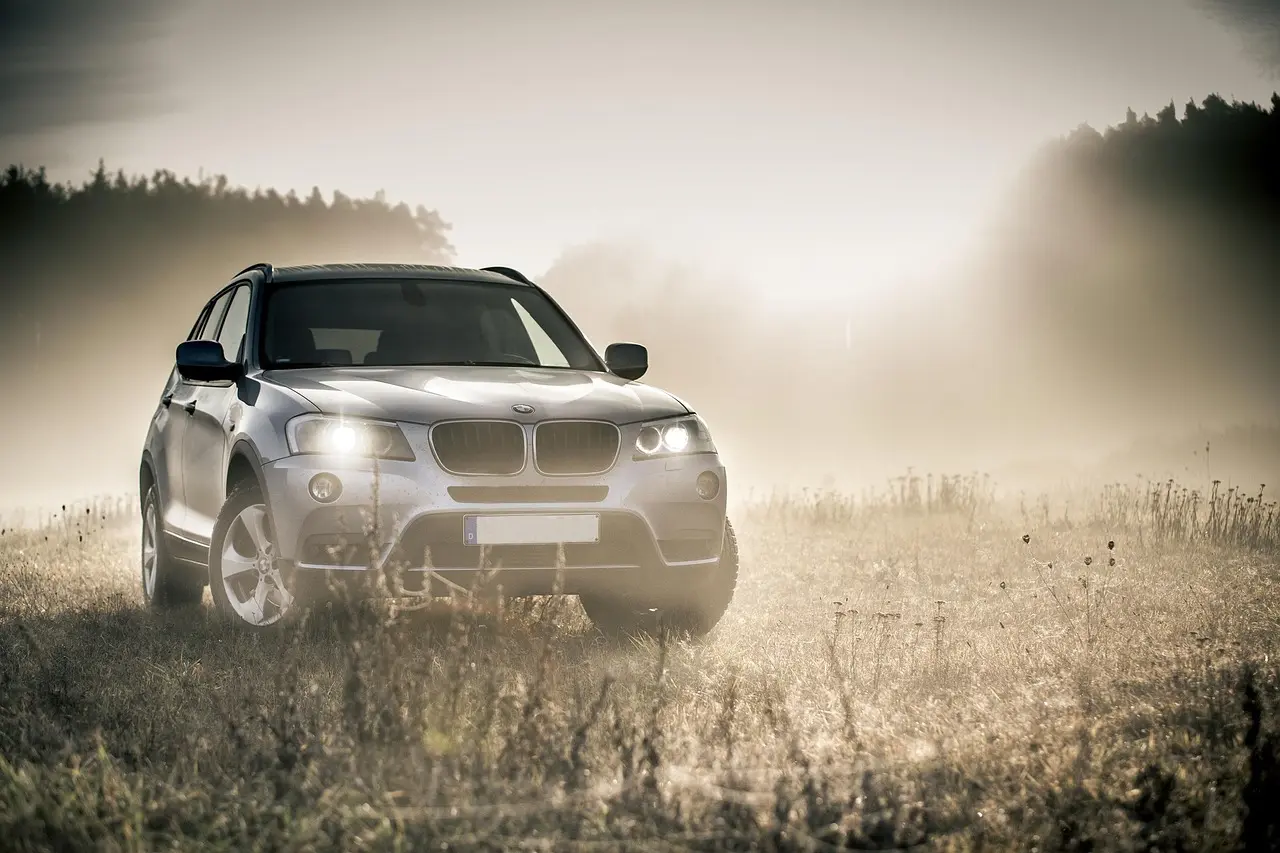
Dipped headlights come first. Use them in fog instead of main beam, then add front fog lights only if visibility has fallen enough that dipped headlights alone are no longer enough. Fog lights do not replace normal headlights, and they should not be switched on for light mist or ordinary night driving.
Use the 100-metre trigger
A practical rule of thumb is to consider fog lights when visibility drops below 100m. That is roughly the length of a football pitch, so if you cannot clearly judge that far ahead, the fog has reached the point where front fog lights may be useful. This is a guide rather than a legal threshold.
A common first-timer mistake is to switch on every lamp at once. If your lane markings are still easy to see and the car ahead stays visible for several lamp posts, dipped headlights are enough, and front fog lights would likely add glare for others.
When should you use rear fog lights in fog?
Use rear fog lights only when vehicles behind genuinely cannot see your car well enough. They are there to make the rear of the vehicle more visible, not to improve your own view. If traffic can already see your tail lights clearly, rear fog lights can create unnecessary glare.
Switch them off early
Rear fog lights should come off as soon as visibility improves. On a clear stretch after a fog bank, or when you move into slower traffic where the car behind is close enough to see normal tail lights, leaving rear fog lights on can annoy or dazzle following drivers.
Modern European cars are described as having at least one rear fog light, and misuse can lead to a Fixed Penalty Notice. A penalty may apply in some cases, so treat the switch as temporary, not standard kit for every wet day.
Can you use main beam in fog?
No. Main beam should be avoided in fog because it reflects light back into the driver and reduces visibility. The brighter the beam, the more backscatter you can get from the water droplets in the air. That can make the white wall effect worse, not better.
Use the beam that cuts glare least
Dipped headlights are the safer default because they light the road without blasting light straight into the fog. Front fog lights can help because they are usually mounted low and give a wide, flat beam that stays under some of the reflected haze.
Modern LED headlight units can add to the problem when they are too bright or badly aimed. In fog, extra brightness is not the goal. Clean lenses and correct beam aim matter more than adding more light.
Drive more safely in fog
Keep more space
Leave more room than the 2-second rule gives you. A common base figure in adverse weather is 3 seconds, and in icy, reduced-visibility conditions the gap may need to be 4 seconds. That extra space gives you more time to react if the car ahead brakes hard or vanishes in a thicker patch of fog.
- Pick a fixed marker. Choose a sign, lamp post, or bridge ahead and count seconds after the vehicle in front passes it.
- Expand the gap. If you reach the marker in under 3 seconds, ease off and let the space grow. In icy fog, aim for 4 seconds.
- Hold a steady pace. Avoid abrupt braking unless the road ahead is clear and you need to stop.
Motorways, dual carriageways, and junctions
Fog can thicken fast on open roads, especially on motorways and dual carriageways where traffic speed is higher. Stay alert for sudden changes in visibility, spray from large vehicles, and patches of mist near cuttings, bridges, and junctions. Fog conditions can change quickly, so a clear stretch can vanish in seconds.
Picture a motorway where you can see 150 metres one moment and only the chevrons on the verge the next. That is the point to slow down early, keep dipped headlights on, and use rear fog lights only if the traffic behind has become difficult to see.
Stopping or parking at the roadside
If you have to stop, use sidelights or parking lights, and prefer a safe off-road parking area if possible. Visibility to other motorists is limited in fog, so a roadside stop needs extra care. Do not leave rear fog lights on once you are parked, because they can confuse approaching drivers.
- Move clear of traffic. Get off the carriageway if there is any safe lay-by or off-road space.
- Switch to sidelights. Use parking lights only if you must remain visible while stopped.
- Check the rear again. If traffic is no longer struggling to see you, turn rear fog lights off.
Heavy rain, spray, snow, and ice
Fog lights can also help in heavy rain or spray from other vehicles, but only when visibility has genuinely dropped. In light drizzle or ordinary wet roads, they may create more glare than benefit. Snow and ice bring the same caution: use them only if the reduced visibility is severe enough to justify the extra light.
If you are behind a lorry in heavy spray and the lane markers fade, dipped headlights remain the base choice. If the spray hides the car behind from view, rear fog lights may be justified for a short stretch, then should come off again as soon as the view clears.
Common mistakes
- Using main beam in fog. It reflects back and cuts visibility. Stay on dipped headlights.
- Leaving front fog lights on too early. In light mist or drizzle, they can dazzle others without helping much.
- Forgetting rear fog lights. If the weather clears or traffic closes in, switch them off promptly.
- Driving too close. Keep at least 3 seconds in poor weather, and 4 seconds in icy, reduced-visibility conditions.
- Stopping with bright lamps on. If you must park roadside, use sidelights or parking lights instead.
Frequently asked questions
Should you use dipped headlights or fog lights in fog?
Dipped headlights should be your first choice. Front fog lights only come in when visibility is severely reduced, typically around 100 metres or less. Rear fog lights are separate again and are only for when drivers behind genuinely cannot see you well enough.
When should you turn on front fog lights in fog?
Turn them on when fog has reduced visibility to roughly 100 metres or less, or when the road ahead is hard to read with dipped headlights alone. Turn them off again as soon as the view improves, because they are meant for poor visibility, not normal driving.
Can you use main beam headlights in fog?
No. Main beam sends light into the fog and reflects it back toward you, which reduces visibility. Use dipped headlights instead. If the fog is severe, front fog lights can help, but they still do not replace dipped headlights.
What visibility means fog lights are allowed?
A common practical threshold is around 100 metres. That is roughly the length of a football pitch, so if you cannot clearly see that far ahead, front fog lights may be appropriate. If visibility is better than that, dipped headlights are usually enough.
Are fog lights legal to use all the time?
No. Fog lights are for poor visibility, not as a permanent lighting setting. Misuse can lead to a Fixed Penalty Notice. Use them only when conditions justify them, then switch them off when the weather clears.
How do fog lights affect other drivers?
They can help other drivers see your vehicle, but they can also dazzle if left on when they are no longer needed. Front fog lights can add glare in mist or drizzle, and rear fog lights are especially bright from behind. Use both sparingly and switch them off early.